Zeitgaist
Cross-Lingual Social Intelligence
Ask in English. Find Chinese, Russian, Arabic takes you'd never discover otherwise.
2023
Post-ChatGPT Launch
Built while mainstream assistants were still knowledge-cutoff-limited
89%
Internal Top-10 Relevance
Dense retrieval plus reranking vs 72% embedding-only baseline
6
Social Platforms
Twitter, Reddit, HN, Mastodon, Bluesky, 4Chan
20+
Languages
Cross-lingual search with automatic translation
The Problem
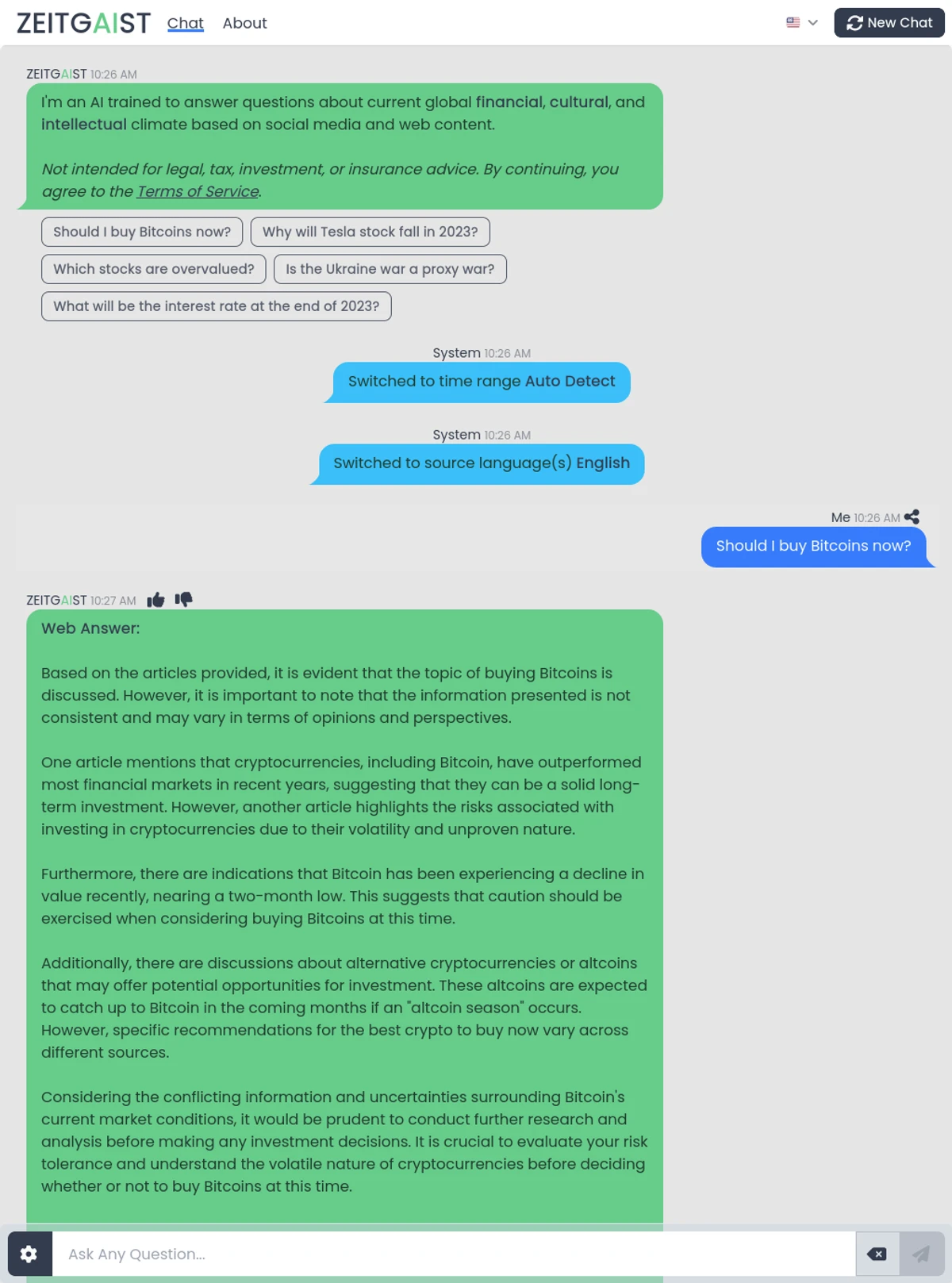
Zeitgaist started immediately after ChatGPT's first public launch, when mainstream assistants still answered from training data and a fixed knowledge cutoff rather than live retrieval. Decision-makers in finance, marketing, and research needed current public-opinion context across Twitter/X, Reddit, Hacker News, Mastodon, Bluesky, and other platforms. Manual monitoring is time-consuming, critical insights in non-English sources are missed, and traditional search lacks temporal context, source attribution, and precise filters. Ask "why did real estate prices surge recently?" against Chinese sources and you get completely different answers than English - geopolitical drivers, local policies, cultural factors that Western media doesn't cover.
The Solution
Built a unified backend serving two complementary products - an AI chatbot for conversational queries and an analytics dashboard for trend visualization. In product terms, it was a Perplexity-like answer engine with a deeper social-media index and user-controlled time, language, platform, and location filters. The retrieval system uses dense embedding search followed by cross-encoder reranking, which improved internally evaluated top-10 relevance from 72% to 89% over an embedding-only baseline. Initially tried single-stage retrieval but found accuracy degraded on cross-lingual queries - the two-stage approach improved result quality at acceptable latency (~200ms p95 in the retrieval path).
Tech Stack
Backend
AI/ML
Frontend
Infrastructure
My Role: Founder & Lead Developer
- Designed and built two-stage retrieval architecture with pgvector
- Positioned the product as an early real-time RAG answer engine while mainstream assistants were still knowledge-cutoff-limited
- Implemented Sentence Transformers retrieval with cross-encoder reranking
- Built multi-language support for 20+ languages with automatic query translation
- Created real-time WebSocket streaming with MessagePack binary serialization
- Developed conversation memory with context-aware query reformulation
- Built two SvelteKit frontends (Chat + Social dashboard)
- Deployed production infrastructure with Docker Swarm and Traefik
Key Differentiators
Early Post-ChatGPT Real-Time RAG: Built live retrieval and source attribution while mainstream assistants were still knowledge-cutoff-limited
Perplexity-Like With Social Depth: Combined answer generation with a social-media index and precise time, language, platform, and location filters
Multi-Platform Aggregation: Unified search across 6 diverse social networks
Dense Retrieval + Cross-Encoder Reranking: internal relevance evaluation improved over embedding-only search
Cross-Lingual Intelligence: Ask in English, get insights from Chinese, Arabic, Russian sources
Temporal Awareness: LLM-powered understanding of time-based queries
Full Source Attribution: Every AI response includes numbered citations with timestamps
Want to discuss this experience?
I am open to full-time Senior Data & AI Platform Architect roles where this kind of data modeling, platform, and production AI work is useful.
Other Projects
Enterprise IoT Platform
Multi-Tenant Workflow Automation Infrastructure
Reduced customer onboarding time by 70% and eliminated an estimated 40+ hours/month of manual DevOps while the architecture was designed for 1,000+ isolated workflow instances.
Foretale
No-Code Crypto Trading & Real-Time NLP Platform
Platform processed 100K+ daily source events across 7+ sources with ML-powered sentiment analysis, OCR extraction, and visual workflow automation.