Patented Fire Simulation Controller
Electronic Control System for Industrial Fire Testing
Full-stack from PCB to Windows GUI - built in high school
1
Patent
Device later covered by DE102008011567B4
4
Stack Layers
PCB → Firmware → Driver → GUI
2007
Built In
As high school summer intern
The Problem
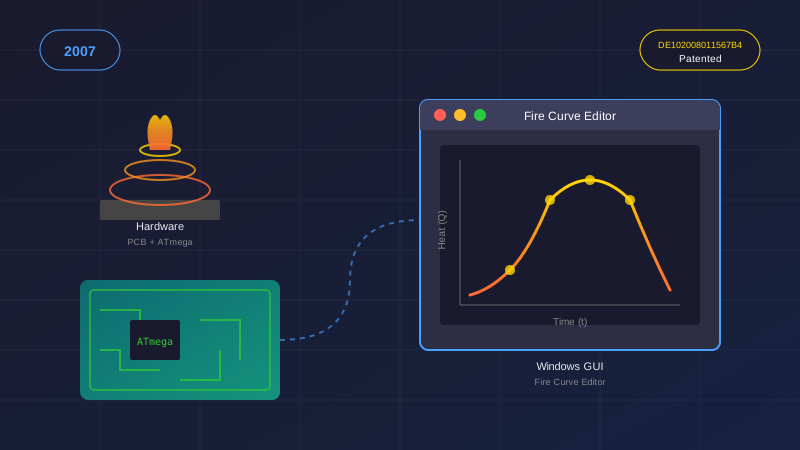
Fire protection engineers at Halfkann + Kirchner needed to test smoke extraction systems in buildings by simulating realistic fire progression. They had designed a sophisticated multi-level gas burner device with adjustable burner rings, but needed an electronic control system that would allow precise control of multiple gas burner levels, programmable fire curves matching real fire behavior, real-time adjustment during tests, and a user-friendly interface for drawing custom fire progression curves. Without this, the mechanical device couldn't be operated with the precision required for standardized fire safety testing.
The Solution
As a high school summer intern, I designed and built the complete electronic control stack. For the hardware layer, I created a custom PCB design for the control interface, handling signal routing between the microcontroller and gas valve actuators. The firmware layer consisted of an ATmega microcontroller programmed in C and Assembler for real-time control, handling precise timing for gas valve control, temperature sensor reading, and serial communication with the host PC. I developed a Windows DLL driver enabling the GUI application to communicate with the hardware via serial protocol. Finally, the application layer was a Windows desktop application with a graphical fire curve editor where engineers could literally draw the desired heat release curve with their mouse, and the system would execute it precisely via the gas burner arrays. The system enabled smooth, programmable fire simulations that could replicate various fire scenarios, from slow-building fires to rapid flashover events. One thing I learned quickly working with fire safety engineers: fire rarely kills people directly - smoke does. The control system therefore needed to execute realistic fire progression profiles for tests where smoke extraction performance was the real concern.
Tech Stack
Hardware
Firmware
Desktop
Domain
My Role: Electronic Control System Developer (Intern)
- Designed custom PCB for hardware control interface
- Programmed ATmega microcontroller firmware in C/Assembler
- Developed Windows DLL driver for hardware communication
- Built Windows GUI application with graphical fire curve editor
- Implemented real-time control loop for precise fire curve execution
- Delivered complete system as paid summer internship
Key Differentiators
Full-Stack Hardware to GUI: Complete control system spanning PCB → Firmware → Driver → Desktop Application
Graphical Fire Curve Editor: Engineers could draw custom heat release profiles by hand
Patent Context: Built control subsystem for a device later covered by a granted German patent
High School Project: Delivered professional-grade industrial control system as a teenager
Want to discuss this experience?
I am open to full-time Senior Data & AI Platform Architect roles where this kind of data modeling, platform, and production AI work is useful.
Other Projects
Enterprise IoT Platform
Multi-Tenant Workflow Automation Infrastructure
Reduced customer onboarding time by 70% and eliminated an estimated 40+ hours/month of manual DevOps while the architecture was designed for 1,000+ isolated workflow instances.
Zeitgaist
Cross-Lingual Social Intelligence
Synthesizes current insights from 6 platforms in seconds vs hours of manual monitoring, with cross-lingual search and filterable source context.