Caudra
The complete coding agent for your terminal
Caudra is a free, open source coding agent that runs in your terminal. I created and maintain it, and I use it for my own work every day.
17
Built-in model providers
Plus local models and custom endpoints
20B+
Tokens a month in my own use
Measured in my daily use, not a benchmark
<1 s
To load or save a 10k-turn session in my own use
Measured by hand in my daily use
<2 GB
For over a month of my own history
Measured in my daily use
The Problem
I spend most of my working day with coding agents, and I have tried many of them. I kept adding plugins to get the features I wanted. Often I could not build the plugin I needed, because the agent had no hook in the place it needed one. A proper /goal mode was one of them. Keeping the plugins I did have up to date was work of its own.
The Solution
So I built those features into the agent itself, where they can work together. Caudra is one binary I can install in a new environment with one command, and it works with small local models as well as flagship ones. Caudra is an independent fork of Maki. It keeps the native Rust core of Maki and adds completion goals, durable subagents, steering, revert, and the workbench. Caudra opens in Plan mode and writes only its plan until you approve it. In Build mode, file edits inside the repository run freely, shell and web tools ask first, and deny rules always win.
Tech Stack
Core
Models
Integration
Platforms
My Role: Creator & Maintainer
- Created Caudra as an independent fork of Maki and maintain it
- Built the features I wanted from plugins into the agent itself, such as a proper /goal mode
- Use Caudra for my own work every day and push more than 20 billion tokens a month through it
- Use ninfer-4090, my hobby port of NInfer-3090, as a local model and decision engine for Caudra
Platform Components
ninfer-4090 as a local model
Caudra talks to ninfer-4090 through the OpenAI Responses API, as it does with any other provider. It also uses the ninfer prefill progress and prompt-cache features described below.
- While ninfer prefills a request, it streams processed, total, and cached token counts. Caudra draws them as a prefill-rate bar above the input.
- Caudra sends a prompt cache key per session and marks the end of its system prompt with a cache breakpoint. ninfer routes the session to its cached state and reuses the system prompt and tools across new sessions.
ninfer-4090 as a decision engine
The decision engine in Caudra sends typed questions to a decisions endpoint. On ninfer-4090 it runs on the decision-1 adapter, in the same process and on the same weights as the chat model. Answers come back as probabilities from prefill, without decoding. The measured median for six questions on an 8,205-token state cached on the GPU is 101 ms.
- Permission advice and Auto mode screening for tool calls
- Shell effect predictions
- Content screening of tool results
- Routing of subagents to the Fast or Best model
- Reranking of memory notes, code context, and history matches
- decisions.decide() and decisions.rerank() calls inside code snippets
Key Differentiators
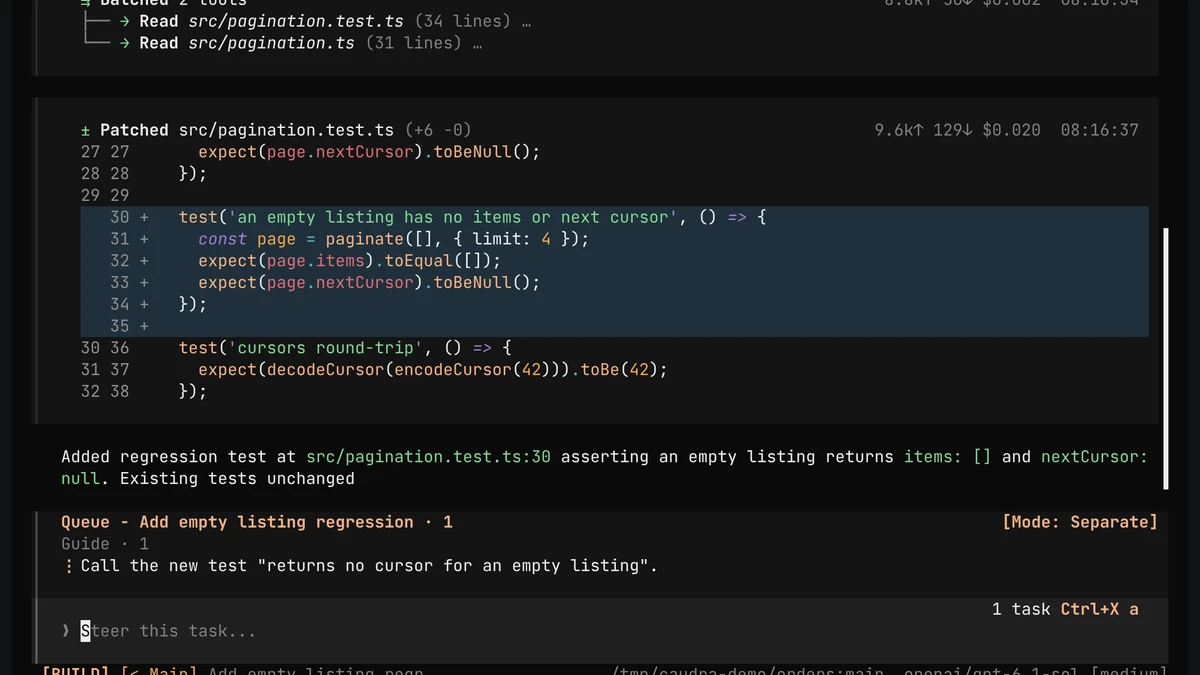
You can open the chat of a running subagent and type. The subagent reads your guidance at its next turn while the main agent keeps working.
/goal keeps a session working until a separate evaluator finds your condition met.
Workcell, the tool layer in Caudra, filters shell output before the model reads it. Most of its filter rules come from RTK. One click shows the raw output.
Caudra records every tool call that may change files, so a revert touches only the files those calls changed.
It works with 17 built-in providers, local models through Ollama or llama.cpp, and custom endpoints that speak a supported API.
It runs on macOS, Linux, and Windows, and each platform installs with one command. On macOS and Linux that is curl -fsSL https://caudra.ai/install.sh | sh.
Want to discuss this experience?
I am open to full-time Senior Data & AI Platform Architect roles. My resume lists the rest of my work.
Other Projects
Enterprise IoT Platform
Multi-Tenant Workflow Automation Infrastructure
Reduced customer onboarding time by 70% and eliminated an estimated 40+ hours/month of manual DevOps while the architecture was designed for 1,000+ isolated workflow instances.
Zeitgaist
Cross-Lingual Social Intelligence
Synthesizes current insights from 6 platforms in seconds vs hours of manual monitoring, with cross-lingual search and filterable source context.